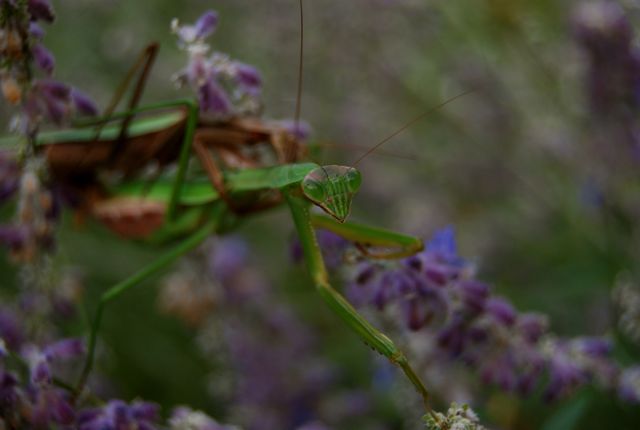
We have a large butterfly bush in our front yard which attracts a huge variety of insects. Butterflies (of course), as well as all types of bees, flies, – this year we even had a hummingbird! Pretty darn rare in the city. Anyway. b/c of the number of butterflies, this bush is also home to a large cadre of praying mantises. Mantids LOVE butterflies. Their tender juicy middles in particular. After gobbling them up, they drop the butterflies’ colorful but otherwise unappealing wings to the floor below. So all summer long, while I’m weeding the garden, my daughters are gathering up the wings like so many discarded petals.
When I was a kid I never saw a praying mantis. But I clearly remember people saying they were endangered, and telling me never to kill one. I believe it was illegal at the time (the 1980s), but I haven’t been able to confirm or deny that. All I know for certain is that mantids are thriving in 2008 – at least in our yard. If a postage-sized stamp of a garden in the middle of a city is any indication of the greater picture, I’d say they’re doing fine.
And yet each time we find a praying mantis, you’d think it was the very first time. We drop everything. Holla to each other. COME QUICK! B/c we all want to see. Their thoughtful eyes and slender grace are fascinating. My daughters found a small one several weeks ago – of all places, beneath a checkout in Trader Joes. They scooped him up, and carried him out of the store. He seemed happy to be free. But rather than hop off outside the exit, he rode for blocks on my older daughter’s hand. Only once we reached the Market Street bridge did he fly off, soaring stories into the sky.
We’ve been fortunate enough to capture several others over the years. Not in any box, but on film. My skillful husband took these photos a couple weeks ago of a pair mating, and I just had to share them. They are beautiful. The text is excerpted from the North Forty News. Many thanks for sharing.
PS: We now have a large egg case on one of the branches. Here’s to next year’s offspring!
This brings us to the delicate subject of mantid love – or, more precisely, mantid sexual behavior.
Slender adult male mantids, smaller than the female, usually feature brown tones in contrast to the female’s greens. They display rather slow, deliberate care around prospective mates, often approaching from the rear and leaping on the female’s ample back when close enough. Females warrant this caution, even though their substantial weight keeps them grounded while males can fly, because a female may hunger for a substantial meal more than sex.
Sometimes she wants both.
Even attached and fully engaged, a male may literally lose his head servicing his chosen female. The female can swivel her head in a disconcertingly human-like gesture and decapitate her suitor. This may not even interrupt the act at hand. One author states that “removal of the male’s head, the bit which the female eats first, releases the male’s genitalia from nervous inhibition from the brain and leads to incessant copulatory movements.”
The smartest–or the luckiest–males avoid this circumstance, however, leap off their temporarily groggy paramour and run quickly away. Such mortal danger may insure that only the smartest males live to mate again.
Once inseminated, a female searches for a plant stem or fence post suitable for making an egg case and laying her eggs. Usually she selects a location 1 to 4 feet off the ground and constructs a case that resembles tan foam with the texture of a roasted marshmallow. Chinese mantids build round cases; the Europeans flatten theirs on one side.